The Archimedean Spiral
An exploration into the elegant mathematical curve defined by constant radial progression and its diverse applications in science and engineering.
Learn More 👇 Discover Uses 💡Dive in with Flashcard Learning!
🎮 Play the Wiki2Web Clarity Challenge Game🎮
Introduction
Definition
The Archimedean spiral, also known as Archimedes' spiral or the arithmetic spiral, is a fundamental curve named after the 3rd-century BC Greek mathematician Archimedes. It represents the locus of points traced by an object moving away from a fixed point at a constant speed along a line that rotates with constant angular velocity.
In polar coordinates (r, θ), it is precisely defined by the equation:

Here, b is a real number that dictates the distance between successive loops of the spiral. The position r is directly proportional to the angle θ, signifying a constant rate of outward movement relative to the rotation.
Historical Context
Archimedes meticulously described this spiral in his seminal work, On Spirals. Historical accounts suggest that Conon of Samos, a contemporary mathematician and friend of Archimedes, may have been the original discoverer of this curve, as noted by Pappus of Alexandria.
Mathematical Derivation
Physical Approach
Consider a point object moving in the Cartesian plane with a constant velocity v parallel to the x-axis, relative to the plane itself. Simultaneously, let the entire xy-plane rotate with a constant angular velocity ω about the z-axis. If the object starts at position (c, 0) at time t = 0, its velocity components (vx, vy) and the magnitude of its velocity relative to the fixed z-axis can be derived using principles of relative motion.
The resulting velocity components are:
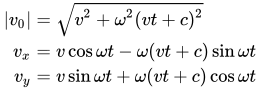
The distance from the origin at time t is given by vt + c.
Parametric Equations
By integrating the velocity components vx and vy with respect to time, we obtain the parametric equations for the spiral in Cartesian coordinates:
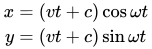
Substituting ωt = θ and t = θ/ω, and simplifying, leads to the polar form r = (v/ω) θ + c, which is equivalent to the standard form r = bθ when c = 0 and b = v/ω.
Arc Length and Curvature
Arc Length Calculation
The length of the Archimedean spiral, parameterized by f(θ) = (bθ cos θ, bθ sin θ), between angles θ1 and θ2 is given by the integral:
![{\displaystyle {\frac {b}{2}}\left[\theta \,{\sqrt {1+\theta ^{2}}}+\ln \left(\theta +{\sqrt {1+\theta ^{2}}}\right)\right]_{\theta _{1}}^{\theta _{2}}}](https://wikimedia.org/api/rest_v1/media/math/render/svg/c8ba4747b8530f217bf568171fb75502e3db3c14)
This formula utilizes the inverse hyperbolic sine function (arsinh) as an alternative representation.
Curvature Analysis
The curvature κ of the Archimedean spiral quantifies how sharply it bends at any given point. It is dependent on the parameter b and the angle θ, expressed as:
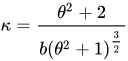
This formula reveals that curvature changes significantly as the spiral progresses outwards.
Key Characteristics
Constant Separation
A defining property of the Archimedean spiral is that any ray originating from the center intersects successive loops of the spiral at points separated by a constant distance. This distance is precisely 2πb when the angle θ is measured in radians. This consistent spacing is the reason for its designation as the "arithmetic spiral," contrasting with logarithmic spirals where these distances form a geometric progression.
Two Arms and Symmetry
The spiral consists of two distinct arms, one generated for positive angles (θ > 0) and the other for negative angles (θ < 0). These arms meet smoothly at the origin. The arm for θ > 0 is essentially a mirror image of the arm for θ < 0 across the y-axis.
Dynamic Behavior
For large values of the angle θ, a point moving along the Archimedean spiral approximates uniform acceleration. This behavior aligns with the conceptual origin of the spiral: a point moving with constant speed along a line rotating at a constant angular velocity.
Generalized Forms
Extended Equation
The concept of the Archimedean spiral can be generalized to include other related spiral curves through the equation:
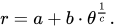
The standard Archimedean spiral corresponds to the specific case where c = 1 and a = 0.
Related Spirals
This generalized form encompasses several other notable spirals:
- Hyperbolic Spiral: Occurs when c = -1.
- Fermat's Spiral: Occurs when c = 2.
- Lituus: Occurs when c = -2.
These variations demonstrate the rich family of curves related to the fundamental principles of spiral motion.
Diverse Applications
Geometry and Computation
Historically, Archimedes utilized the spiral to develop methods for geometric constructions, including approximations for squaring the circle and trisecting an angle, which relaxed the constraints of traditional compass-and-straightedge methods.
Mechanical Engineering
The spiral's geometry finds application in mechanical devices. Scroll compressors, used for gas compression, often employ rotors based on interleaved Archimedean spirals or similar curves. The coils of watch balance springs also form Archimedean spirals.
Electronics and Signal Processing
Spiral antennas, utilized in various electronic applications, are designed using Archimedean spirals due to their frequency-independent properties. In digital display technology, Digital Light Processing (DLP) projectors use rapidly spinning color wheels with Archimedean spiral patterns to create the illusion of simultaneous color display and minimize the "rainbow effect."
Scientific Measurement
In medicine, the ability of patients to draw an Archimedean spiral is used to quantify human tremor, aiding in the diagnosis of neurological conditions. In microbiology, the spiral plate method employs the spiral's geometry for quantifying bacterial concentrations.
Physics and Astronomy
The spiral pattern appears in natural phenomena. The solar wind creates a Parker spiral, and astronomical observations, such as the dust patterns around stars like LL Pegasi, exhibit approximate Archimedean spirals, often influenced by gravitational interactions in binary systems.
Construction Methods
Geometric Approximation
Precise construction using only a classical compass and straightedge is impossible due to the spiral's defining characteristic of constant radial increase. However, accurate approximations can be achieved. A common method involves subdividing a circle's circumference into equal arcs (e.g., 12 arcs of 30 degrees) and its radius into proportional segments. Concentric circles are drawn based on these radii, and points are marked where the radii intersect the corresponding circles, creating a series of points that approximate the spiral when connected.
Mechanical Devices
Mechanical approaches offer more direct construction. A modified string compass, where the string winds around a fixed pin, naturally generates the spiral as the radius changes with angle. More sophisticated devices utilize non-rotating shafts with helical threads (akin to Archimedes' screw) and linked arms to precisely trace the curve, allowing for adjustments in pitch and precision based on machining accuracy.
Teacher's Corner
Edit and Print this course in the Wiki2Web Teacher Studio

Click here to open the "Archimedean Spiral" Wiki2Web Studio curriculum kit
Use the free Wiki2web Studio to generate printable flashcards, worksheets, exams, and export your materials as a web page or an interactive game.
True or False?
Test Your Knowledge!
Gamer's Corner
Are you ready for the Wiki2Web Clarity Challenge?

Unlock the mystery image and prove your knowledge by earning trophies. This simple game is addictively fun and is a great way to learn!
Play now
References
References
Feedback & Support
To report an issue with this page, or to find out ways to support the mission, please click here.
Disclaimer
Important Notice
This page has been generated by an Artificial Intelligence system and is intended solely for informational and educational purposes. The content is derived from a specific snapshot of publicly available data and may not encompass all nuances or the most current understanding of the subject.
This is not professional mathematical or scientific advice. The information provided herein should not substitute for consultation with qualified mathematicians, physicists, engineers, or other relevant experts. Always verify critical information and consult official documentation or specialists for specific applications or research needs. Reliance on the information presented here is at the user's own risk.
The creators of this content are not liable for any errors, omissions, or consequences arising from the use of this information.